Crowded markets don't always need better products. They need better questions.
Most mature product categories eventually reach the same point. Performance improves. Engineering evolves. Materials become lighter. Manufacturing becomes more efficient. Every competitor invests in innovation and most of that innovation moves in the same direction. Customers notice the improvements. Few of them can explain why one product genuinely feels different from another.
At Ticket Design, the most valuable opportunities rarely come from asking how to improve an existing product. They come from stepping back and asking whether the industry has been solving the right problem in the first place. The difference sounds small. In practice, it can reshape an entire category.
Our work with Crompton Greaves Consumer Electricals on Air Buddy is a useful example.
By 2019, Crompton already held close to 29 percent value market share in the domestic fan industry. The category had absorbed decades of genuine engineering progress. Motors were quieter. Energy efficiency had improved. Finishes were more refined. Every major manufacturer was investing in real improvements, and the market was competitive precisely because those improvements were real.
It was also remarkably predictable.
When Air Buddy, a compact blade-free kitchen fan, launched in October 2019 at ₹3,500, initial inventory sold out within days. The launch campaign generated 5.7 million impressions in five days, a 4 percent click-through rate, and more than a lakh visits to e-commerce platforms in its first week.
The product succeeded for a specific reason. It was not a better ceiling fan. It was the market’s first acknowledgment that the kitchen needed its own fan, designed around its own user.
When products compete on the same assumptions
The pattern repeats across industrial design work, whether the product is an appliance, a medical device design, or a piece of industrial equipment. As markets mature, competitors optimise the same characteristics. A fan gets quieter. A water purifier gets smarter. A medical device gets smaller. Engineering teams solve real problems, quality genuinely improves, and yet businesses find themselves competing on increasingly similar ideas.
Specifications become easier to compare than experiences. Feature lists grow longer while differentiation shrinks. Customers notice incremental gains but struggle to say why one product should win their money over another.
This is rarely a creativity problem. It is a framing problem, and industrial design has a chance to correct it before a single concept sketch exists.
Design begins before the product becomes visible
People associate industrial design with what they can see. Silhouette. Colour. Material. Proportion. These decisions matter, and they shape how a product is perceived. At Ticket Design, they are rarely where a project starts.
Every successful product begins with something less visible. How people behave. Where they hesitate. What they have quietly stopped questioning, simply because no better alternative has ever presented itself.
A spreadsheet can compare features. It cannot explain why someone wipes condensation off a control panel every morning, or bends awkwardly to reach a switch that has always sat in the wrong place. Observation fills that gap. User research, done well, is less about asking people what they want and more about noticing what they have stopped expecting. Those unnoticed adaptations tend to hold the strongest opportunities, because they expose a need nobody has bothered to name.
Looking beyond the product category
Working across consumer appliances, healthcare, mobility, packaging, and industrial products has one clear advantage. Patterns repeat. Challenges that look unique inside one industry often exist elsewhere under a different name.
People adapt to imperfect solutions. Businesses treat those adaptations as normal. Given enough time, the compromise becomes invisible, and product development narrows to refining the existing answer rather than questioning whether the original question still holds.
The kitchen was exactly this kind of blind spot. Ceiling fans had been designed exceptionally well for living rooms and bedrooms for decades. Very little of that attention had reached the person standing beside a stove for hours at a stretch. Nobody had decided to overlook her. The omission simply stopped being visible.
A user everyone had learned to ignore
Crompton’s own consumer research found that homemakers typically spend four to five hours a day in the kitchen, one of the most occupied rooms in an Indian home and one of the warmest. Gas burners, boiling vessels, steam, and hot oil operate at once, creating conditions that a living-room fan was never built to address.
Ethnographic research took the design team into homes across several cities. The conversations began with behaviour rather than product ideas, anchored by one simple question asked repeatedly: what do you do when the kitchen gets too hot?
Nobody described an ideal solution. Everyone described a workaround. Discomfort had become part of cooking, not because people saw it as unavoidable, but because no product had ever been built to solve it. For the design team, the challenge shifted entirely. The question was no longer how to improve an existing fan. It was why people had been adapting for so long in the first place.
Every existing solution solved a different problem
Once the research came together, one thing was clear. The market was not short of kitchen products. None of them had been designed around the person cooking.
Ceiling fans moved a wide column of air and got switched off the moment the gas was lit, because that same column disturbed the flame. Exhaust fans pulled smoke and odour out of the room, offering the cook at the stove almost no relief. Chimneys solved ventilation properly, but stayed concentrated in modular kitchens, a small and mostly urban slice of Indian homes. Pedestal fans could point air at a person, but took up floor space and sat too close to an open flame to use safely.
None of these products was poorly designed. Each one solved a real problem. None of them solved this one. Recognising that gap was the turning point for the project. Industrial design is often less about replacing what exists and more about noticing where something that works perfectly well still leaves a need unresolved.
Reframing the brief before designing the product
Most product development projects start with a straightforward goal. Improve performance. Cut manufacturing cost. Refresh the look. Add a feature. These are reasonable goals, and they rarely capture the full opportunity.
One of the most valuable stages at Ticket Design happens before any sketch exists. The brief itself gets questioned. A small shift in framing can lead to a completely different outcome, and that is what happened with Air Buddy.
The obvious brief would have been better airflow from another appliance. Research pointed somewhere else entirely. The kitchen was not a smaller living room. It was a distinct working environment built around one person doing one demanding task. Once the brief became “design for the person at the stove” rather than “design for the room,” every decision that followed had a clear test to answer to.
Design decisions shaped by behaviour
With the brief reset, the process moved faster, because every major decision traced back to something observed in research rather than an assumption about what a kitchen appliance should look like.
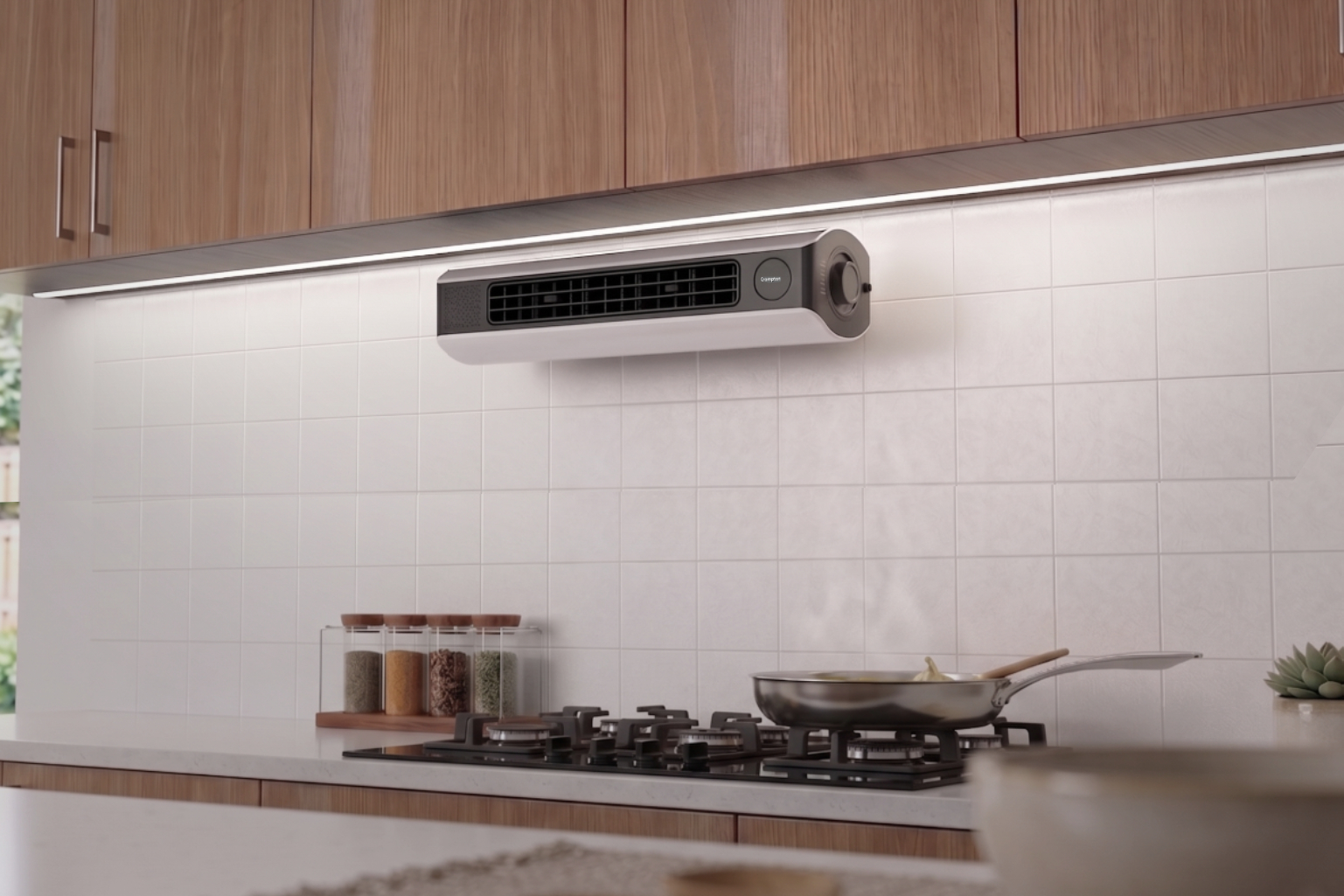
The result was Air Buddy, a 55 cm blade-free tower fan built around a 38 W AC induction motor. A tangential blower delivers a soft, directional stream of air toward the user, in place of the broad circulation a ceiling fan produces. The goal was never to cool the kitchen. It was to cool the person in it, exactly where the heat was worst.
Kitchen layouts in Indian homes vary enormously. Some have overhead cabinets. Some offer only a bare wall. Some households wanted a fixed installation, others wanted to carry the fan from room to room as seasons changed. A single mounting method would have excluded a meaningful share of that market on day one.
Air Buddy answered this with four mounting configurations built from one SKU. Fixed under a wall cabinet. Fixed vertically on a bare wall. Freestanding on a designer base as a tower fan for the living room or bedroom. Set directly on the countertop for instant use. One purchase now served several rooms across the year. Good industrial design frequently creates value this way, by making a single product relevant across more situations rather than multiplying specialised ones.
Manufacturing shapes every good product
Customers notice the visible parts of a product first. Long-term success depends just as much on the parts they never see. Material choice affects durability. Tooling affects consistency. Assembly affects production efficiency. Service access affects how long the product survives in someone’s home.
None of this shows up in advertising. All of it shapes whether a customer keeps enjoying the product a year after buying it. Air Buddy’s filter was built to wipe clean in one stroke. Its compact footprint respected how little space most kitchens can spare. Its neutral finish let the same product sit comfortably in a kitchen, a bedroom, or a study. None of these decisions stood alone. Together they let the product fit into daily life without asking anyone to adapt to it.
Success was measured by recognition, not novelty
When Air Buddy reached the market, customers understood immediately what it was trying to do. Products rarely create demand from nothing. More often they hand people a language for a problem they had already been living with.
Rangarajan Sriram, then Vice President for Fans at Crompton, described Air Buddy at launch as a response to a simple consumer insight the team hoped to solve, at a moment when people were spending more time in the kitchen than almost anywhere else in the home. Successful products do not always need new technology. Sometimes they simply notice familiar behaviour more carefully than anyone else has bothered to.
The commercial numbers followed that recognition. 5.7 million campaign impressions, a 4 percent click-through rate, and more than a lakh e-commerce visits within five days of launch. Those results were Crompton’s execution, built on a campaign the client owned outright. Ticket Design’s part was the work underneath it: the research, the product logic, and the industrial design that gave the marketing something true to say.
What this means for founders and product teams
A common assumption in product development is that differentiation comes from adding features. The strongest opportunities usually sit earlier than that, before engineering starts, before a concept exists.
A few questions tend to open that ground. Which user has quietly adapted to an inconvenience nobody has named. Which assumption has the category stopped questioning. Which everyday friction has survived years of refinement simply because it became invisible. Whether the brief in front of you is solving the right problem at all.
None of these questions produce an immediate answer. They tend to produce a better product a few months later.
Why an outside perspective matters
Businesses bring in an external design consultancy largely for perspective. Internal teams know their products deeply, and that depth comes with inherited assumptions built up over years of product evolution. An outside team arrives without them, which makes it easier to notice a compromise the business stopped seeing a long time ago.
At Ticket Design, this shows up as cross-category experience, carried across consumer appliances, healthcare, mobility, packaging, and industrial products. A lesson learned in one category regularly surfaces an opportunity in another, in ways that benchmarking a single industry never quite reaches.
Better questions create better categories
Crowded markets rarely lack engineering talent or manufacturing capability. What they usually lack is a reason for a customer to look at the category differently, and that reason begins with a question rather than a technology.
Air Buddy did not succeed by adding another fan to a full shelf. It succeeded because the project challenged an assumption the category had stopped examining for decades. The opportunity was never sitting inside a new motor or a different material. It was sitting inside behaviour so ordinary that nobody had thought to call it a problem.
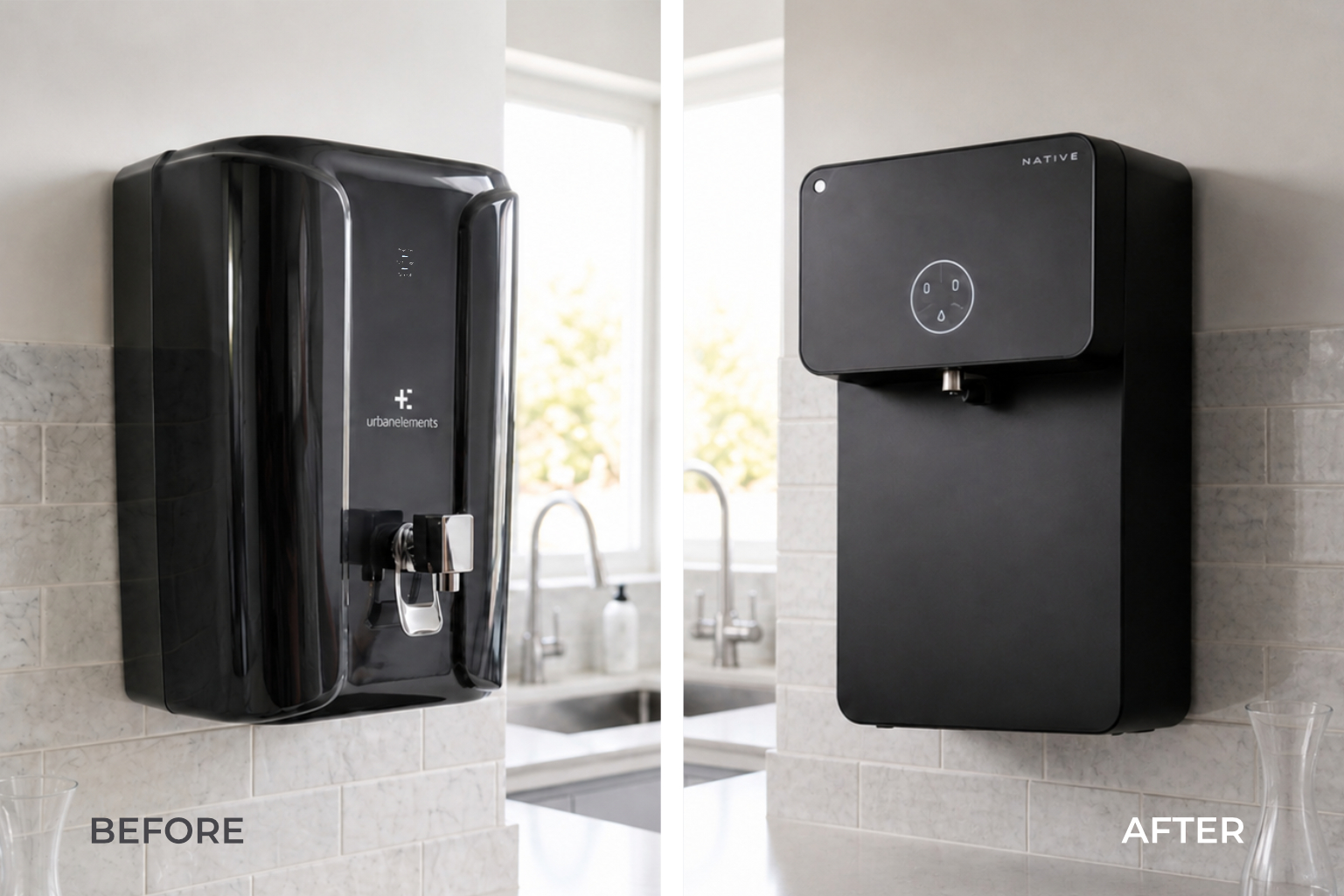
The same approach has shaped other work for us, including the Blossom ceiling fan for Crompton, winner of the Red Dot Product Design Award and the Good Design Japan Award, and Native, the water purifier built for Urban Company, whose division reported ₹116 crore in FY25 revenue, a 303 percent increase year on year. Different markets, same underlying discipline. Understand the behaviour before you define the product.
Industrial design cannot remove every compromise a category has learned to live with, and it should not try. Its job is to work out which compromises were never necessary in the first place.
At Ticket Design, every project starts with the same plain question. What has everyone stopped noticing?
The answer usually points to the next product worth building.


